Methods Of Resistance: A personal essay
Luar FW25 “El Pato”, DeBí TiRAR MáS FOToS, and ‘Rasquachismo’.
A few years ago, I found myself in a heated conversation with a boy in my high school Spanish class. He was trying to tell me that, in his firm belief, “there is no culture in this country besides American culture.” He was so sure in his stance and unable to see otherwise, despite the irony that we were communicating in Spanish, in a class where we learned about culture. I debated with him until the end of the period, bringing up our proximity to the mix of cultures in New York City and the people who immigrated into the country to come here. “How could you think that?” I asked him. “Are you just choosing to ignore entire populations of people who don’t originate from here? Like your own family?”
I was born in New York to an interracial couple on January 6, 2000. I grew up in New Jersey, in a small town, a majority white community. My culture? A New York love story: Dominican, Italian, and Puerto Rican.
I tend to find myself at the intersection of political ideas as a person of mixed identity. We are living in a time where the erasure of ethnic culture is a real, foreboding issue that is impacting hundreds of communities across the US. It’s easy to sulk away from the current news cycle and its negativity, but there are positive ways we can respond. As the youth of the US, it’s important that we use our voices, and not shy away from the agenda of this oppressive administration. It is imperative to contribute to the collective national culture in a way that uplifts one another and our differences, now more than ever.
This year, the day before my birthday we were given a gift in the form of Bad Bunny’s album, DeBí TiRAR MáS FOToS. The songs celebrate the essence of Puerto Rico and Benito’s fears of losing the island to rampant colonization and tourism. The short film that accompanied the album followed the story of an older man, who had gone to his local bakery to purchase a traditional Puerto Rican breakfast. He was unaware that the bakery had taken new owners, and the white woman at the counter acted as though she didn’t understand him when he tried to order. She repeatedly mispronounced the foods native to Puerto Rico, and after multiple misunderstandings while taking his order, she explained that they are unable to take his payment in cash “per corporate policy.” He asked if he would be able to pay her later, he knew the original owner, but she refused. Then, a native Puerto Rican offered to pay for his meal. “Seguimos aquí” he told him, ‘we are still here.’
One Sunday not long after the album was released, my parents, tías, and tíos, sat closely around a phone at our kitchen table, watching the short film. “This made me so upset,” my tía turned to me. We all nodded in understanding, thinking of my grandparents and great grandparents, and the traditions that this type of gentrification aims to erase.
Robert Bedoya discusses notions of resisting gentrification through the Chicano practice of ‘rasquachismo’ in his profound piece, “Spatial Justice: Rasquachification, Race and the City”. Rasquachification or ‘rasquachismo’ is essentially the Mexican American practice and aesthetic of making due with what one has through creativity and resourcefulness. Bedoya discusses how Rasquachification rebels against the ‘white spatial imaginary’ - “an antiseptic ethos that effectively deemed being poor and of color as civic imperfections to be expunged.” The white spatial imaginary suggests that any person of color and the aesthetics belonging to them are a threat. Bedoya concludes that the outward expression of Chicano culture – whether it be painting houses in vibrant colors or repurposing a tire into a flower pot – Rasquachification resists the white spatial imaginary and gentrification.
While the music of DeBí TiRAR MáS FOToS serves as a direct response and warning to the dangers of gentrification, we also see a different version of Rasquachification present in the cover art as well. The album cover shows two empty white plastic chairs sitting on grass in front of a bunch of platanos, plantain plants. There has been much discussion surrounding the significance of the chairs, being that they are very inexpensive and accessible. For many POC, they are a cultural symbol for parties and family gatherings. Analyses of the album art assert that the empty chairs signify the photos Benito wishes he took with family and friends during these gatherings. The main theme of the album conveys a feeling of nostalgia, for times past and the authentic culture of Puerto Rico.
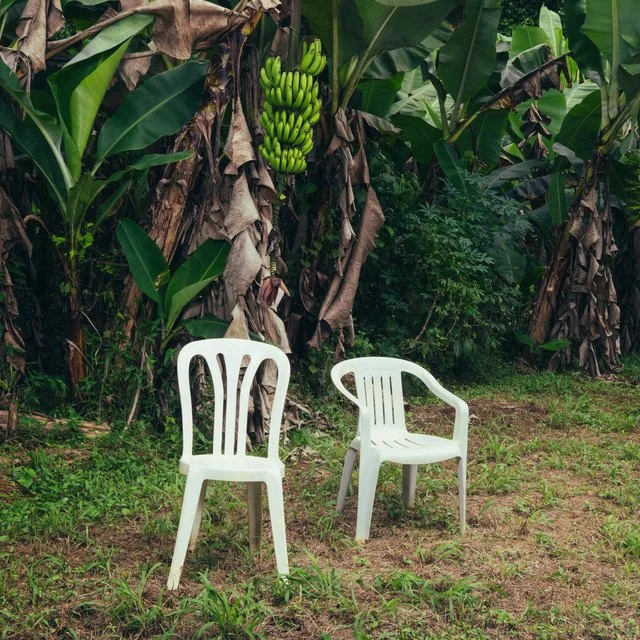
DeBí TiRAR MáS FOToS Album Cover.
I would be remiss not to mention another pillar of my culture that I was fortunate enough to work on this season, which left a lasting impact. Luar FW25 “El Pato”, a breakthrough Dominican brand by designer Raúl Lopez, debuted their collection for New York Fashion Week on February 10. The theme for this collection was centered on reclaiming “El Pato” - the derogatory phrase used to describe gay people in Dominican and Puerto Rican communities. The direct translation of the phrase means “the duck”, as reflected in the iconography and use of feathers throughout the collection. Lopez explained that the inspiration for the show is the evolution of a gay person coming into their own, through dressing up and making due with what they have to affirm their identity.
Cathy Horyn at The Cut describes Luar as being a brand of resistance, “resistance to the tame and ordinary, in the form of a bomber covered extravagantly with glossy black feathers or a white version made of faux feathers sheathed in clear plastic.” Other designs featured in the collection included jumpsuits with a restrictive hood that fixed the wearer’s arm to present their limp wrist - a gesture widely known to describe a person as being gay. Through innovative and intentional design, Luar celebrates and embraces notions of flamboyance.
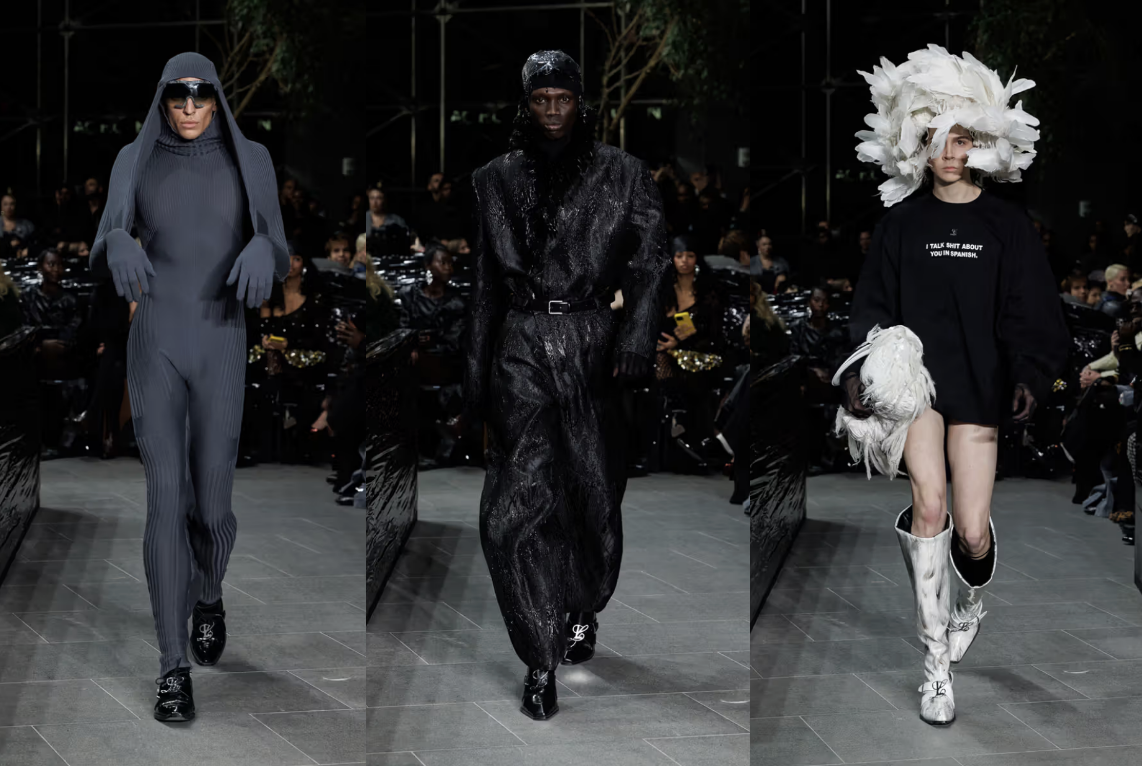
Looks from Luar FW25 “El Pato”.
Kyle Luu, the lead stylist for the show explained more on the use of materials for the FW25 collection, “It’s like this collage of feathers and beading and a lot of tape, because that is a natural thing to do when you’re broke and have to figure out a solution. It feels very real to this story” (Interview Magazine). Duct tape was used to secure intricately designed headpieces, as seen on models’ heads as they walked down the runway. Lopez explained that many of his first collections were put together with this inexpensive tool. At the magnitude that Luar has reached today, it is incredibly profound that this method of ‘rasquachismo’ is being honored. During an interview with Lopez and Luu before the show, Taylore Scarabelli of Interview Magazine dubbed the use of duct tape, “the foundation of the community.”
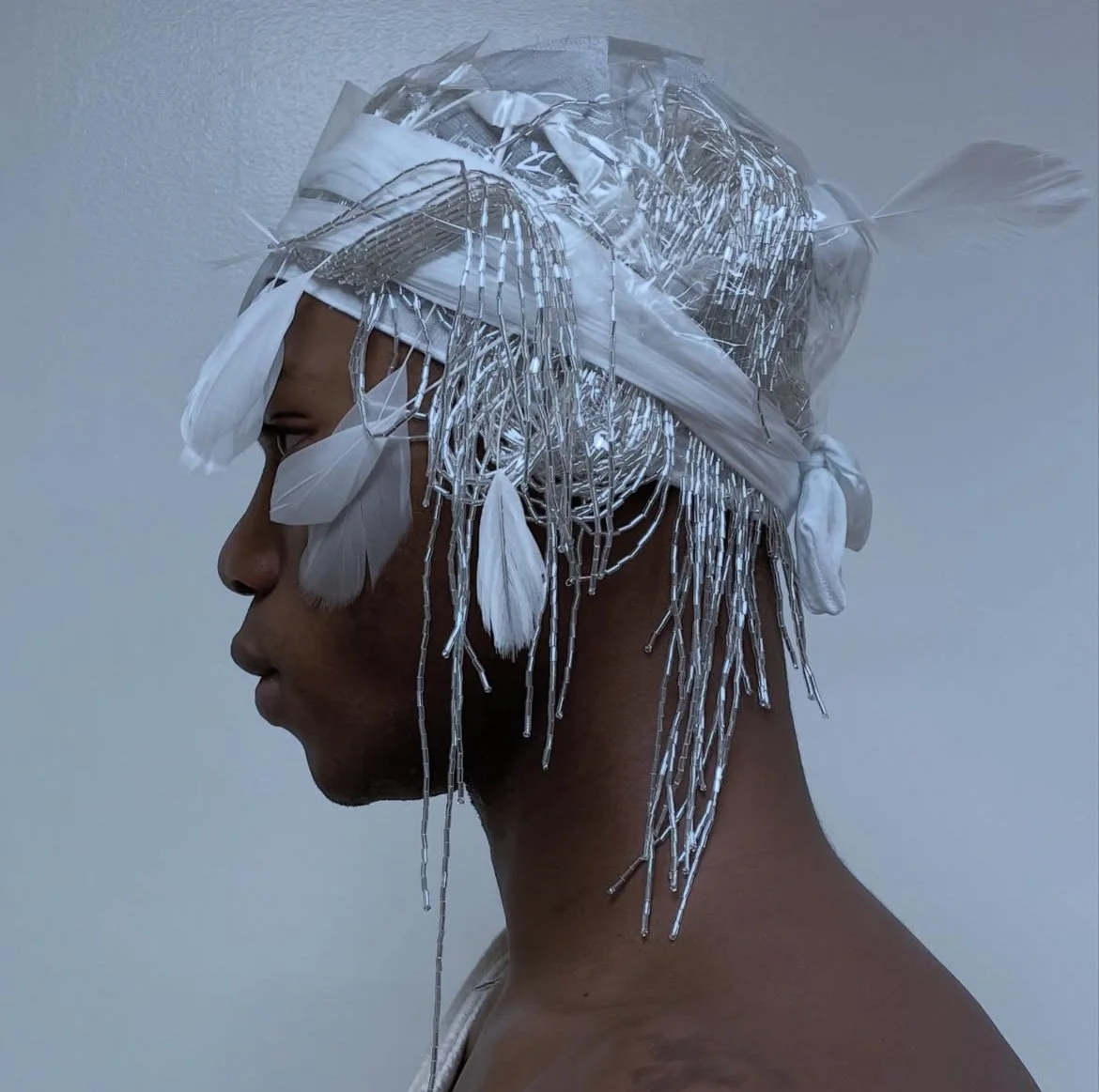
Luar FW25 headpiece by Kyle Luu.
This is especially impactful given the attack on the LGBTQ+ community by the current presidential administration. Although Lopez explains that this collection is not a political response, but rather a reflection on where we are as a society. He tells Vogue Runway about the feeling behind the collection, “I had strifes against me for being Latino, being flamboyant, for being gay, dressing the way I dressed – I am not going in the closet for nobody ever again. And I feel like right now, we are at a point in our lives where we want to show people that and we want to tell people we’re here and we’re not going anywhere.”
The celebration of eccentricity, flamboyance, and the common journey of a gay individual is especially important at this point in time. Personally, I have always understood Luar’s designs as being incredibly Dominican in aesthetic and in outward expression, similar to the way we talk – it is not quiet. Luar is to be seen and heard on a global scale. The platform that Lopez has created with his brand serves as an indicator of the state of society and the way the LGBTQ+ community is widely embraced thanks to modern ideologies and the spread of ideas through social media. The younger generation is a testament to these ideas.
“Why not unite? And like, we all move this whole world together,” Lopez explained, “And Luar is that. I always say this is a platform to bring people together, immerse people in a really beautiful experience, and enjoy a time of prosperity, love, abundance, joy, and immersing people in the same way I feel - I want people to feel that when they come to my show.”
Luar is not letting us go backward in time. With the phenomenon of DeBí TiRAR MáS FOToS, Bad Bunny is shedding light on a national issue that needs to be felt and addressed. The erasure of cultures by means of gentrification and white-washing is an active threat to communities across the US. The current administration is stripping away rights from the LGBTQ+ community and the rights of immigrants. This is a critical issue that is impacting the larger society, and American culture as we know it.
To me, American culture is a beautiful mix of cultures that has allowed for my family to come here and for me to literally exist. I am mixed race, the cultures on either side of my family are not the same – but it is the beauty of the US that allowed for them to coexist and find one another.
Methods of resistance like these need to be celebrated and amplified on a daily basis. It is important to celebrate your culture and personal eccentricities now more than ever. The current administration is trying to take us backwards by influencing society’s thinking through propaganda, it is incredibly important to resist this through acts in daily life. Be proud of who you are and celebrate the differences of your peers. Acts of defiance like these are important and needed.
Unify against the white spatial imaginary and gentrification that seeks to erase our culture and the sacrifices of our family members who fought for us to be here. The US is not made of one culture. Let them see you, make them uncomfortable by never dimming your light. Let your presence be felt. Be empowered.
I implore you to be yourself, celebrate yourself. We are living in a time where simply being yourself as a black or brown person – or as a woman, or member of the LGBTQ+ community – is alone an act of resistance. Do not let anyone erase that, not this administration or anybody.
Wave your flag and continue talking about “El Pato”. Play DeBí TiRAR MáS FOToS as loud as you want to and dance merengue in the street. Let them see you. Aquí nos quedamos – we’re staying here.
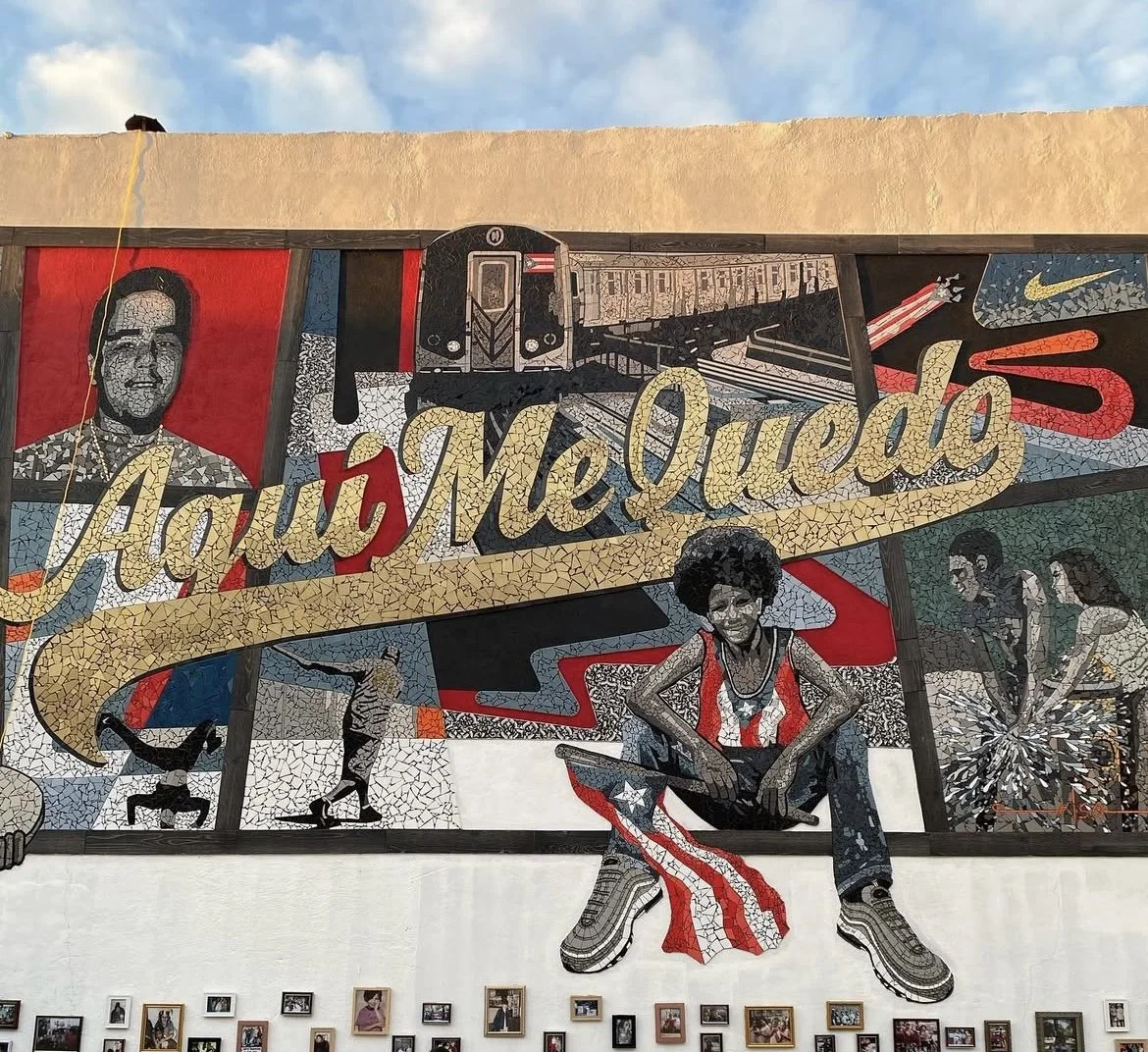
Aquí Me Quedo Mural in Brooklyn, NY.